MEXISTENCIALISMO UN ALMA CHABACANO
María Osado
Nos experimentamos cada vez más como apariencias, confundiendo la visibilidad con el significado y la performance con la verdad. Pocas contradicciones definen con mayor precisión la vida contemporánea. La visión de Maria Osado se mueve dentro de este territorio incómodo, rompiendo ideas heredadas y eurocéntricas sobre la belleza y la legitimidad, en busca de un lenguaje visual arraigado en las contradicciones del México contemporáneo. Recorriendo la Ciudad de México como observadora y participante—a través de la moda, el cine, el casting y la creación de imagen—Maria rastrea las frágiles negociaciones entre intimidad y exposición, deseo y comercio, reinvención y desaparición. Si el mexistencialismo pregunta cómo permanecer humano dentro de la contradicción, Maria insiste en la atención—al yo, a la ciudad y al costo de convertirse en imagen.
AA: ¿Cuándo te sientes más viva en la Ciudad de México? ¿Y cuándo la ciudad te parece vacía, artificial o ajena?
MO: Gran parte de la vitalidad que logro sentir en la Ciudad de México viene del equilibrio entre mi vida pública y mi vida privada. En cuanto a lo privado, no hay lugar donde logre regresar más a mi centro que en la casa de mi abuela, en Magdalena Contreras, y siento algo muy parecido también en casa de mis padres. Ambos lugares han permanecido en la familia por generaciones. Tengo la fortuna de que no son solamente santuarios de mi paz, sino también de la memoria. También existe una conexión profunda que siento con el espacio público y con el caos de estar rodeada de completos desconocidos. Pero entre la prisa y los antagonismos que atraviesan la Ciudad de México, hay pausas que intento cultivar—o simplemente permitir—para que la curiosidad y la sorpresa me reconecten con el presente. Las calles y el transporte público también me parecen espacios llenos de vitalidad. Y cuando se trata de la gentrificación, no puedo evitar sentir cierta resistencia ante el reemplazo de lo viejo por lo nuevo. La Ciudad de México se vuelve profundamente artificial cuando intenta homogeneizarse. Una de las imágenes más recurrentes en mi mente es la de una colonia donde ninguna casa es igual a la otra, donde cada una tiene una fachada distinta. Cuando las cosas intentan volverse homogéneas e idénticas, se vuelven muy, muy artificiales para mí.
AA: ¿Cuál es la diferencia entre el estilo como forma de expresión y el estilo como protección? ¿En qué momento la estética se convierte en una máscara?
MO: El estilo como forma de expresión está profundamente ligado al proceso—ya sea a través de la investigación, de las relaciones con otras personas o de encontrarte en un lugar donde alguien te inspira. También creo que es una experiencia más colectiva, aunque muchas veces la asociamos con algo individual. Tiene que ver también con el deseo de convertirse en algo. Y en ese deseo de convertirse, creo que constantemente nos estamos poniendo y quitando la máscara. Nada de eso es permanente. Hay una enorme diferencia entre los códigos con los que creces socializando y las tendencias que te venden—esas que eventualmente terminas comprando. Ese tipo de máscara me parece un poco más peligrosa. Lo vemos constantemente en la moda. Y la mayor desventaja que le veo a la máscara es cuando te la quitas porque alguien más te dijo que debías hacerlo. Durante la última década trabajando en esta industria, me he dado cuenta de que, aunque la moda alguna vez funcionó como un sistema para imponer deseos, también podría estar perdiendo parte de su poder. Ahora que todo el mundo tiene la posibilidad de documentar su vida y convertirse en protagonista de su propia historia, también se convierte en punto de referencia. Las cosas están cambiando, y la inspiración ahora llega desde muchos más lugares y rincones. Últimamente he sido testigo de un cambio muy rápido en la publicidad. A través de conversaciones con colegas de la industria—y simplemente caminando frente a espectaculares gigantes—puedes ver cómo la imagen hegemónica y eurocéntrica de la belleza está recuperando fuerza. Me gustaría pensar que hubo un periodo, por breve que haya sido, en el que los límites se expandieron—cuando las apariencias en la publicidad realmente comenzaron a cambiar, cuando cuerpos de tallas más grandes empezaron a ocupar espacios que antes nunca habían ocupado. Y en un abrir y cerrar de ojos, terminó. Creo que en México existe una relación inseparable entre lo que dicta Estados Unidos y la forma en que México lo recibe y adopta. Al mismo tiempo, México está creando algo propio.
AA: Hoy toda persona creativa tiene que negociar íntimamente con el capitalismo—algoritmos, branding, visibilidad, autopromoción. ¿Cómo te mueves dentro del sistema sin dejar que te vacíe por dentro?
MO: En diez años de carrera, nunca me había topado con una pared como la que he encontrado estos últimos dos años con toda la idea de vender—venderme, vender lo que hacemos—especialmente cuando hablamos de redes sociales. Al principio, veía las redes como esta posibilidad inmensa de conectar con un mundo que durante muchos años parecía muy lejano: la moda. Y la idea de poder construir una audiencia que acompañara el camino de mi proyecto—sin tener que depender de los grandes medios ya existentes—se sentía increíblemente refrescante.
En los primeros años de Guerxs, también significaba conectar bajo nuestros propios términos: sin un guion diseñado por alguien más, sin pedir permiso y sin contactos. Pero ahora, diez años después, siento que nos está asfixiando—la necesidad constante de exponernos a un mundo virtual que ni siquiera vemos todos los días. No es una realidad tangible. Y a pesar de todo su potencial, personalmente me siento muy distante de ello, incluso traicionada por ello. Porque dentro de esta idea de creatividad infinita, lo que cada vez veo más es repetición—copiar, copiar, copiar. El algoritmo te dice exactamente lo que quiere: corta tus videos, ya no son horizontales, ahora tienen que ser de este formato. Es una relación agotadora. Creo que necesitamos volver—aunque sea desde nuestra propia trinchera—a un espacio que priorice la narrativa sobre el estilo, la historia sobre la estetización de la imagen. Otra forma de moverse dentro del sistema—al menos para mí, sin terminar completamente vaciada por dentro—es aprender a ser selectiva. Selectiva con los proyectos de los que formas parte, y rechazar la trampa de la relevancia constante. Hacer las paces, de vez en cuando, con el anonimato. Y con no ser visible.
AA: ¿Qué imagen de las calles de la Ciudad de México captura mejor la verdad emocional del país en este momento? No el cliché—lo real.
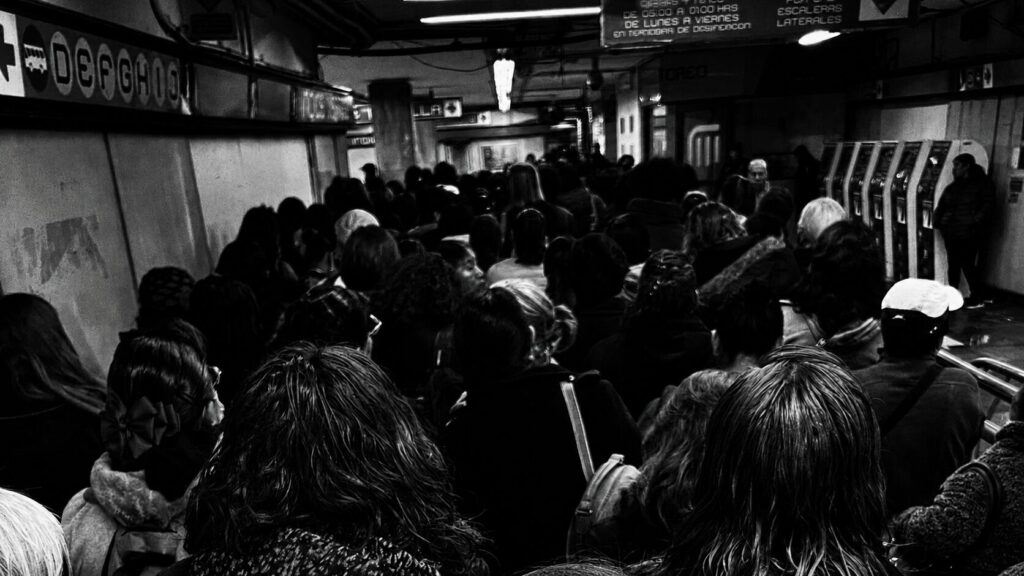
MO: Tendría que decir la estación Chabacano del Metro. El Metro es el rostro subterráneo de la ciudad, y aunque técnicamente no es una calle al aire libre, cumple la misma función de movimiento y tránsito. Especialmente Chabacano. Siempre hay una cantidad enorme de movimiento. Está la imagen clásica del colapso en hora pico—impulsado por la necesidad, lleno de agotamiento. Pero también existe el colapso por elección. En esa estación suceden muchos eventos culturales, especialmente conciertos. Hay euforia, entretenimiento, conmoción. Para mí, esa contradicción captura algo esencial: un pueblo mexicano que trabaja, y trabaja duro, moviéndose a través de una ciudad donde la movilidad es profundamente caótica. El transporte público en sí mismo me parece un reflejo poderoso del momento presente. Y luego, junto a estas postales mentales de multitudes atravesando la estación, también está lo que existe justo afuera. Frente a la estación hay un nuevo proyecto urbano diseñado pensando en una audiencia global—considerando todas las intervenciones que se hacen para la mirada del visitante. Y sin embargo, muchas veces esas transformaciones no reflejan las necesidades de las personas que realmente viven en la ciudad. Chabacano es la imagen de lo real.
AA: ¿Qué miedo impulsa más secretamente tu trabajo? ¿La irrelevancia, la soledad, la inestabilidad, desaparecer, el fracaso—o algo más?
MO: El miedo a la indiferencia es un motor enorme. Significa elegir una línea de trabajo donde tengo que dejar de ser una extraña en la mayoría de las situaciones a las que entro. Y creo que también la inestabilidad. La inestabilidad financiera también me empuja a seguir produciendo. Hay muchos proyectos que estoy desarrollando actualmente que no tienen financiamiento ni fines comerciales. Ésos son los que preservan la coherencia del mensaje que intento compartir. Y también está el miedo a la desaparición. No tanto la mía, sino la de las personas con las que me encuentro—personas que me motivan o me inspiran. Me dolería profundamente que el mundo nunca llegara a conocerlas.
AA: El mexistencialismo es la lucha por encontrar sentido dentro de la contradicción—por seguir siendo humano en un país que puede sentirse al mismo tiempo violento, íntimo, absurdo, desigual, solitario y cada vez más mercantilizado—¿cómo se vive hoy esa realidad en el sentido más contemporáneo?
MO: Me gustaría poder enfrentar mejor la reconciliación de esas contradicciones desde la vulnerabilidad. Creo que es algo que todavía nos falta mucho por trabajar—permitirnos ser vulnerables. Necesitamos enamorarnos más seguido—entre nosotros, de la ciudad, de los lugares—y a través de esos vínculos buscar su permanencia, volvernos responsables de estos lugares, de estas conexiones, y cuidarlas. Deberíamos intentar sentarnos en mesas con más desconocidos, más seguido, y ver qué es lo que nos conecta en lugar de lo que nos separa.
MEXISTENCIALISMO A CHABACANO SOUL
María Osado
We increasingly experience ourselves as appearances, mistaking visibility for meaning and performance for truth. Few contradictions define contemporary life more completely. Maria Osado’s vision moves through this uneasy territory, rupturing inherited Eurocentric ideas of beauty and legitimacy in search of a visual language rooted in the contradictions of contemporary Mexico. Moving through Mexico City as both observer and participant—across fashion, film, casting, and image-making—she traces the fragile negotiations between intimacy and exposure, desire and commerce, reinvention and disappearance. If mexistencialismo asks how one remains human inside contradiction, Maria insists on attention—to the self, to the city, and to the cost of becoming an image.
AA: When do you feel most alive in Mexico City? And when does the city feel empty, artificial, or alien to you?
MO: A large part of the vitality I’m able to feel in Mexico City comes from the balance between my public life and my private life. In terms of the private, there is no place where I am more able to return to my center than at my grandmother’s house in Magdalena Contreras, and I feel something very similar at my parents’ home as well. Both places have been in the family for generations. I’m fortunate that they are not only sanctuaries of my peace, but also of memory. There is also a profound connection I feel with public space and the chaos of being surrounded by complete strangers. But amid the rush and antagonisms that run through Mexico City, there are pauses that I try to cultivate—or simply allow—so that curiosity and surprise can reconnect me to the present. Streets and public transportation, I think, are also places full of vitality. And when it comes to gentrification, I can’t help but feel a certain resistance to the replacement of the old with the new. Mexico City becomes deeply artificial when it tries to homogenize itself. One of the most recurring images in my mind is of a neighborhood where no house is the same as the next, where each one has a different façade. When things try to become homogenized and identical, they become very, very artificial to me.
AA: What is the difference between style as a form of expression and style as protection? At what point does aesthetics become a mask?
MO: Style as a form of expression is deeply tied to process—whether through research, through relationships with others, or through finding yourself in a place where someone inspires you. I also think it’s more of a collective experience, even though we often associate it with something individual. It’s also about wanting to become. And in that wanting to become, I think we are constantly putting on and taking off the mask. Nothing about it is permanent. There is a huge difference between the codes you grow up socializing within and the trends being sold to you—the ones you eventually end up buying into. That kind of mask feels a bit more dangerous to me. We see it constantly in fashion. And the biggest disadvantage I see in the mask is when you discard it because someone else told you to. Over the last decade, working in this industry, I’ve realized that although fashion once functioned as a system for imposing desires, it may also be losing some of its power. Now that everyone has the ability to document their lives and become protagonists of their own stories, they also become points of reference. Things are changing, and inspiration now comes from many more places and corners. Lately, I’ve witnessed a rapid shift in advertising. Through conversations with colleagues in the industry—and simply by walking past giant billboards—you can see that the hegemonic, Eurocentric image of beauty is regaining force. I’d like to think there was a period, however brief, when the boundaries stretched—when appearances in advertising actually began to change, when larger body sizes started occupying spaces they had never occupied before. And in the blink of an eye, it ended. I think in Mexico there is an inseparable relationship between what the United States dictates and how Mexico receives and adopts it. At the same time, Mexico is creating something of its own.
AA: Today, every creative person has to negotiate intimately with capitalism—algorithms, branding, visibility, self-promotion. How do you move within the system without letting it hollow you out from the inside?
MO: In ten years of my career, I had never hit a wall the way I have over the last two years with the whole idea of selling—selling myself, selling what we do—especially when talking about social media. At first, I saw social media as this immense possibility to connect with a world that for many years felt very distant: fashion. And the idea of being able to build an audience that could follow the
path of my project—without having to rely on already existing major media—felt incredibly refreshing. In the early days of Guerxs, it also meant connecting on our own terms: without a script designed by someone else, without permission, and without connections. But now, ten years later, I feel like it’s suffocating us—the constant need to expose ourselves to a virtual world we don’t even see every day. It isn’t tangible reality. And despite all its potential, I personally feel very distant from it, even betrayed by it. Because in this idea of endless creativity, what I see more and more is repetition—copying, copying, copying. The algorithm tells you exactly what it wants: cut your videos, they’re no longer horizontal, now they need this format. It’s an exhausting relationship. I think we need to return—at least in our own trench—to a space that prioritizes narrative over style, story over the aestheticization of an image. Another way of moving through the system—at least for me, without becoming completely emptied out inside—is learning to be selective. Selective about the projects you become part of, and refusing the trap of constant relevance. Making peace, from time to time, with anonymity. And with not being visible.
AA: What image from the streets of Mexico City best captures the emotional truth of the country right now? Not the cliché—the real.
MO: I would have to say Chabacano Metro station. The Metro is the underground face of the city, and although it’s not technically a street in the open air, it serves the same purpose of movement and transit. Especially Chabacano. There is always an enormous amount of movement. There’s the classic image of collapse during rush hour—driven by necessity, full of exhaustion. But there’s also collapse by choice. Many cultural events happen in that station, especially concerts. There is euphoria, entertainment, commotion. To me, that contradiction captures something essential: a Mexican people who work, and work hard, moving through a city where mobility is deeply chaotic. Public transportation itself feels like a powerful reflection of the present moment. And then, alongside these mental snapshots of crowds moving through the station, there’s also what exists just outside it. Just across from the station, there’s a new urban project designed with a global audience in mind—considering all the interventions being made for the visitor’s gaze. And yet, so often, those transformations do not reflect the needs of the people who actually live in the city.Chabacano is the image of what is real.
AA: What fear most secretly drives your work? Irrelevance, loneliness, instability, disappearing, failure—or something else?
MO: The fear of indifference is a huge engine. It means choosing a line of work where I have to stop being a stranger in most of the situations I enter. And I think instability too. Financial instability also pushes me to keep producing. There are many projects I’m currently developing that aren’t funded and have no commercial aims. Those are the ones that preserve the coherence of the message I’m trying to share. And also the fear of disappearing. Not so much myself, but the people I encounter—people who motivate or inspire me. It would hurt me deeply if the world never came to know them.
AA: Mexistentialism is the struggle to find meaning within contradiction—to remain human in a country that can feel at once violent, intimate, absurd, unequal, lonely, and increasingly commercialized—how is that reality lived today in the most contemporary sense?
MO: I would like to be able to face the reconciliation of those contradictions better through vulnerability. I think that’s something we still have a lot of work to do—allowing ourselves to be vulnerable. We need to fall in love more often—with each other, with the city, with places—and through those bonds seek their permanence, become responsible for these places, for these connections, and care for them. We should try to sit at tables with more strangers, more often, and see what connects us instead of what separates us.