
MEXISTENCIALISMO: LA CIUDAD DEL INTERIOR
Gala Garrido
Políticamente, estéticamente, sexualmente, ideológicamente—vivimos en una época que huye de la incertidumbre, confundiendo la convicción con la lucidez y la identidad con la autenticidad. Recorriendo el deseo y la muerte de la Ciudad de México—sus soledades, seducciones, contradicciones y disoluciones—Gala Garrido resiste la fantasía de un lugar o un yo permanentes. Para ella, la contradicción no es fracaso, sino devenir; la confusión no colapso, sino condición. Todos vivimos en la ciudad del interior.
AA: La Ciudad de México se siente cada vez más como un lugar donde la identidad misma se ha convertido en una performance—sexual, política, estética, económica. ¿Qué partes de ti se han vuelto performance para sobrevivir aquí, y qué partes la ciudad se ha negado brutalmente a dejarte fingir?
GG: La construcción de identidad siempre contiene un elemento performático. ¿Cómo construimos los seres humanos nuestras identidades si no es a través de conceptos artificiales creados por nosotros mismos? La nacionalidad, el género, la preferencia sexual, el estatus económico, la familia a la que pertenecemos. Vamos poco a poco identificándonos o rechazando etiquetas y conceptos predeterminados para crear algo que sentimos tan propio como la piel. La identidad es una ficción que erróneamente sentimos inamovible. Las experiencias van transformando esa materia, y sin nuestro consentimiento cada segundo somos otros. La migración y el exilio son de las experiencias donde más conscientes nos volvemos de este proceso aparentemente imperceptible, porque para sobrevivir tenemos que adaptarnos rápidamente a una enorme cantidad de cosas. Entonces, ¿cómo construimos nuestra identidad? En función de la supervivencia. Ningún proceso nos lo deja más claro que la migración.
AA: ¿Cómo transforma la Ciudad de México el deseo? No el romance—el deseo. El deseo erótico, el deseo de clase, el deseo creativo, el deseo de convertirse en alguien más. ¿Qué les sucede a las personas aquí cuando el querer se vuelve la condición dominante de la existencia?
GG: El deseo es la condición dominante de la existencia, no solo en esta ciudad. Los seres humanos somos seres deseantes. Eros es la fuerza que permite el movimiento de todos los seres, de todas las especies, de todos los planetas, las estrellas y los sistemas solares. La danza entre Eros y Tánatos es el combustible del proceso infinito de vida-muerte-vida al que pertenecemos. Claro que la exaltación de Eros también exalta la intensidad de Tánatos. Con la misma ferocidad con la que mi Eros se ha expandido en esta ciudad, mi Tánatos me ha arrastrado a procesos brutales. No he tenido tregua ni del Amor ni de la Muerte. Catábasis y Anábasis. Vida-Muerte-Vida. He tenido buena fortuna.
AA: Existe una soledad muy particular en la Ciudad de México—rodeada de millones, deseada por muchos, vista constantemente, y aun así profundamente sola. ¿Qué tipo de soledad fabrica esta ciudad, especialmente para las mujeres?
GG: Las ciudades grandes inevitablemente tienen ciudadanos más solitarios. Los solitarios venimos a estas ciudades buscando exactamente eso. La inmensidad de una ciudad como esta nos permite proteger nuestra soledad, pero también pertenecer, no a una sino a varias comunidades en paralelo. Ambos aspectos son vitales para los artistas. No es posible un proceso creativo sin darle un espacio generoso a la soledad, pero tampoco sin la retroalimentación y la complicidad que una comunidad puede darnos. En cuanto al elemento del género, te respondo con una pregunta: ¿por qué sientes que la soledad sería distinta para las mujeres?
AA: Vivimos en una época de curaduría—los rostros, la política, el trauma, la rebeldía, la feminidad, incluso la autenticidad misma. ¿La autenticidad se ha convertido en otro disfraz? Y si es así, ¿cómo se ve lo real hoy en México?
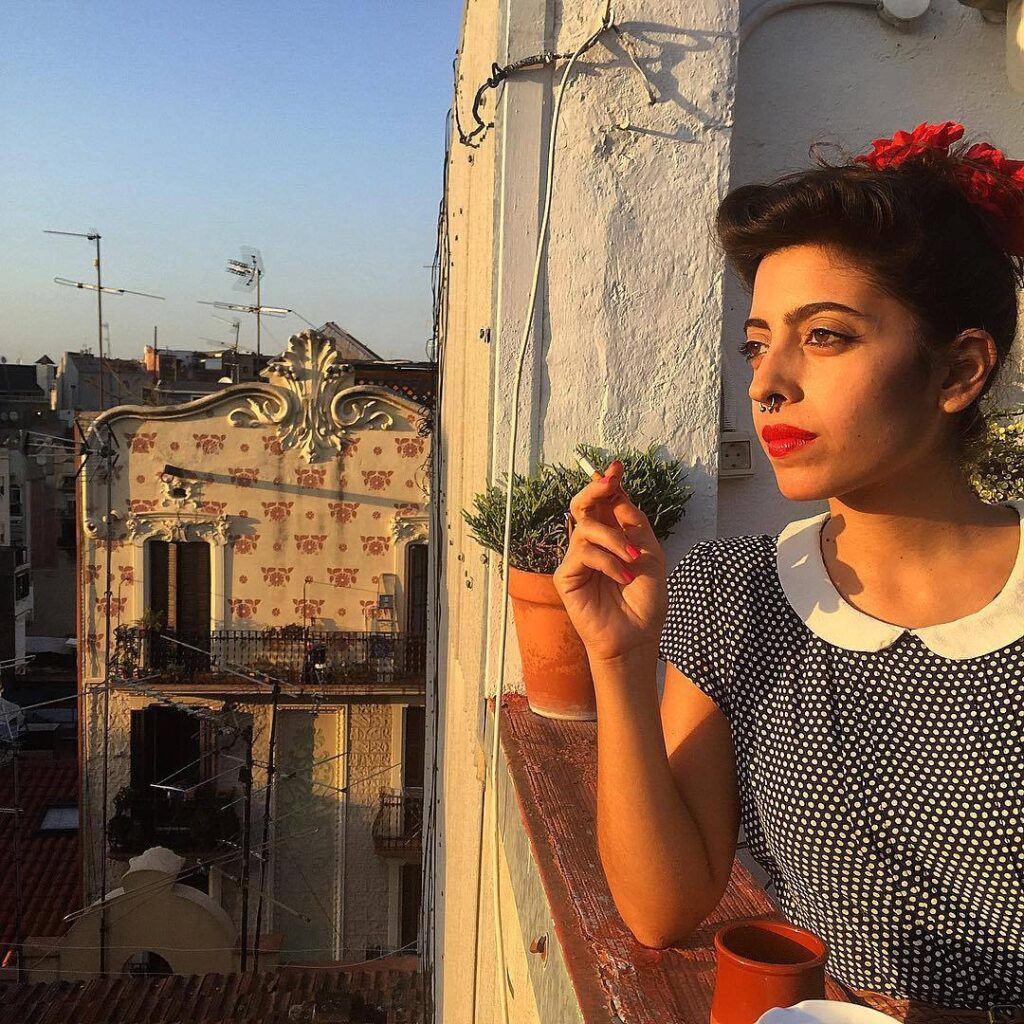
GG: Lo auténtico que nos habita es lo único inmutable. Hay un centro, una piedra, una semilla, un aleph, una gota de noche (elige la imagen que te sea cómoda) que es indivisible, la expresión mínima del infinito. Todos la hemos sentido vibrando en el interior. No hace falta ser Santa Hildegarda y tener La Visión. La certeza de ESO otro que nos habita la tenemos todos. Lo demás es construcción, decisión, simulación, elección. La autenticidad puede o no ser disfraz en función de los parámetros que decidas usar para definirla. Lo real, entendiendo que llamamos “real” a ESO, es real en México y en China. El it de Clarice Lispector. El amado de San Juan de la Cruz. La dama de los templarios. El amante sobrenatural.
AA: La Ciudad de México muchas veces parece suspendida entre el glamour y el colapso—la belleza junto al agotamiento, la ternura junto a la brutalidad, el sexo junto al peligro. ¿Crees que la contradicción se ha convertido en la condición emocional de vivir aquí?
GG: La contradicción y la confusión son elementos fundamentales de la condición humana. Nos transformamos a través de contradecir lo que antes era una verdad para nosotros. Expandemos nuestra visión cada vez que nos permitimos habitar la confusión como un territorio. Lo realmente peligroso son los custodios de sistemas de pensamiento que albergan verdades absolutas, impermeables e inflexibles. Es más cómodo traducir el mundo a través de un panfleto con un número fijo de reglas que enfrentarse a la incertidumbre, a la reflexión propia, a la contradicción, a la confusión. Esto significa estar abierto, permeable, receptivo y en un proceso constante de demolición interior.
AA: ¿Cuál es la mentira más grande que la Ciudad de México les vende a las mujeres—y cuál es la verdad difícil que eventualmente las obliga a confrontar?
GG: No sé cómo responder esta pregunta. Puedo contarte algo sobre mi lectura de la construcción de la feminidad en la CDMX. En cada comunidad construimos la identidad de género de maneras distintas. En Venezuela, por ejemplo, la construcción de lo femenino parte de una hipersexualización que comienza desde edades muy tempranas. Lo que me ha impresionado aquí es otra cosa. Me encuentro en las calles con mujeres adultas que cuando están con sus parejas actúan como niñas pequeñas. Los gestos, el tono de voz deliberadamente agudo, la manera en que reducen sus cuerpos para caber en los brazos de sus compañeros, cómo se dejan llevar de las manos, cómo sus compañeros les hablan chiquito y les preguntan qué quieren. Lo que no deja de sorprenderme es que cuando ves a estas mismas mujeres solas en la calle, se manejan con códigos completamente distintos. Lo que me hace intuir que para ser deseadas está implícito que deben habitar un papel de niñas pequeñas. Me pregunto qué imagen de lo femenino activa el deseo aquí, y qué le sucede a una mujer adulta, con toda su complejidad, dentro de ese esquema.
MEXISTENCIALISMO: THE CITY OF THE INTERIOR
Gala Garrido
Politically, aesthetically, sexually, ideologically—we live in an age that flees uncertainty, confusing conviction with insight and identity with authenticity. Moving through the desire and death of Mexico City—its solitude, seductions, contradictions, and dissolutions—Gala Garrido resists the fantasy of a permanent place or self. For her, contradiction is not failure, but becoming; confusion not collapse, but condition. We are all living in the city of the interior.
AA: Mexico City increasingly feels like a place where identity itself has become a performance—sexual, political, aesthetic, economic. What parts of yourself have become performance in order to survive here, and what parts has the city brutally refused to let you fake?
GG: The construction of identity always contains a performative element. How do human beings construct our identities if not through artificial concepts created by ourselves? Nationality, gender, sexual orientation, economic status, the family we belong to. Little by little, we identify with—or reject—predetermined labels and concepts in order to create something that feels as intrinsic to us as skin. Identity is a fiction we mistakenly experience as immovable. Experience transforms that material, and without our consent we become someone else every second. Migration and exile are among the experiences that make us most conscious of this otherwise imperceptible process, because in order to survive we have to adapt quickly to an enormous number of things. So, how do we construct identity? Through survival. No process makes this clearer than migration.
AA: How does Mexico City transform desire? Not romance—desire. Erotic desire, class desire, creative desire, the desire to become someone else. What happens to people here when wanting becomes the dominant condition of existence?
GG: Desire is the dominant condition of existence, not only in this city. Human beings are desiring creatures. Eros is the force that allows the movement of all beings, all species, all planets, stars, and solar systems. The dance between Eros and Thanatos is the fuel of the infinite process of life-death-life to which we belong. Of course, the exaltation of Eros also intensifies Thanatos. With the same ferocity with which my Eros has expanded in this city, my Thanatos has dragged me into brutal processes. I have had no respite from either Love or Death. Catabasis and Anabasis. Life-Death-Life. I have been fortunate.
AA: There is a very particular loneliness in Mexico City—surrounded by millions, desired by many, constantly seen, and yet profoundly alone. What kind of loneliness does this city manufacture, especially for women?
GG: Large cities inevitably produce lonelier citizens. We solitary people come to cities like this searching for exactly that. The immensity of a city like this allows us to protect our solitude while also belonging—not to one, but to several communities at once. Both aspects are vital for artists. A creative process is impossible without giving generous space to solitude, but also impossible without the feedback and complicity a community can offer us. As for the element of gender, I’ll answer with a question: why do you feel loneliness would be different for women?
AA: We live in an age of curation—faces, politics, trauma, rebellion, femininity, even authenticity itself. Has authenticity become another disguise? And if so, what does the real look like in Mexico today?
GG: What is authentically within us is the only thing that remains immutable. There is a center, a stone, a seed, an aleph, a drop of night (choose whichever image feels most comfortable to you) that is indivisible, the smallest expression of infinity. We have all felt it vibrating inside us. One does not have to be Saint Hildegard and have The Vision. We all possess the certainty of THAT other thing that inhabits us. Everything else is construction, decision, simulation, choice. Authenticity may or may not be a disguise depending on the parameters you choose to define it. The real—understanding that by “real” we mean THAT—is real in Mexico and in China. The it of Clarice Lispector. The beloved of Saint John of the Cross. The lady of the Templars. The supernatural lover.
AA: Mexico City often feels suspended between glamour and collapse—beauty alongside exhaustion, tenderness alongside brutality, sex alongside danger. Do you think contradiction has become the emotional condition of living here?
GG: Contradiction and confusion are fundamental elements of the human condition. We transform ourselves by contradicting what was once true for us. We expand our vision every time we allow ourselves to inhabit confusion as a territory. What is truly dangerous are the custodians of systems of thought that harbor absolute, impermeable, inflexible truths. It is more comfortable to translate the world through a pamphlet with a fixed number of rules than to confront uncertainty, self-reflection, contradiction, confusion. This means remaining open, permeable, receptive, and in a constant process of inner demolition.
AA: What is the greatest lie Mexico City sells women—and what is the difficult truth it eventually forces them to confront?
GG: I don’t know how to answer this question. I can tell you something about my reading of the construction of femininity in Mexico City. In every community, we construct gender identity differently. In Venezuela, for example, femininity is constructed through a hypersexualization that begins at a very young age. What has struck me here is something else. I find myself seeing adult women in the streets who, when they are with their partners, behave like little girls. The gestures, the deliberately high-pitched tone of voice, the way they reduce their bodies to fit into their partners’ arms, the way they let themselves be led by the hand, the way their partners speak softly to them and ask them what they want. What continues to surprise me is that when you see these same women alone in the street, they move through the world according to completely different codes. This leads me to intuit that, in order to be desired, there is an implicit expectation that they inhabit the role of little girls. I find myself wondering what image of femininity activates desire here, and what happens to an adult woman—with all her complexity—within that framework.