
Rebelión de Conciencia
Adolfo Pérez Esquivel — Premio Nobel de la Paz 1980
Rebellion of Conscience
Adolfo Pérez Esquivel — Winner of the 1980 Nobel Peace Prize
Una profunda parálisis se ha apoderado de la psique contemporánea: la escalofriante sensación de que estamos perdiendo —o de que ya hemos perdido— nuestra capacidad de actuar frente a un poder sistémico descomunal. Nos aceptamos como impotentes porque no podemos controlar el resultado, cuando nuestras vidas —nosotros mismos— somos el resultado, y la decisión de actuar sigue siendo nuestra.
A finales de la década de 1970, el artista argentino Adolfo Pérez Esquivel fue encarcelado y torturado por una dictadura militar, después de años de organizar la resistencia no violenta en toda América Latina. Se enfrentó a gobiernos capaces no solo de ignorar la disidencia, sino de encarcelar, torturar y asesinar a quienes se les oponían. En 1980 recibió el Premio Nobel de la Paz.
Pérez Esquivel no poseía un poder ni remotamente comparable al de las fuerzas
A heavy paralysis has settled over the contemporary psyche: the chilling sense that we are losing—or have already lost—our human agency in the face of massive systemic power. We accept ourselves as powerless because we cannot control the outcome, when our lives—ourselves—are the outcome, and the decision to act remains our own.
In the late 1970s, Argentine artist Adolfo Pérez Esquivel was imprisoned and tortured by a military dictatorship after years of organizing nonviolent resistance across Latin America. He confronted governments capable not merely of ignoring dissent but of imprisoning, torturing, and killing those who opposed them. In 1980, he was awarded the Nobel Peace Prize.
Pérez Esquivel did not possess power remotely comparable to the forces he confronted. He could not control the outcome. He could not know whether
a las que se enfrentaba. No podía controlar el resultado. No podía saber si la resistencia tendría éxito. De hecho, en la respuesta que nos envió, recuerda haberse preguntado qué hacía entre «monstruos» que podían devorarlo en un minuto porque tenían poder e impunidad.
Su respuesta no niega la impotencia. Cambia la escala con la que se mide nuestra capacidad de actuar. La verdadera liberación, nos recuerda, no nace de la victoria macropolítica, sino de las enseñanzas de los pobres, los pueblos indígenas y los místicos de la no violencia que se negaron a rendirse ante la desesperación. Para Pérez Esquivel, recuperar nuestra humanidad comienza
resistance would succeed. Indeed, in the response he sent to us, he remembers asking himself what he was doing among “monsters” who could devour him in a minute because they possessed power and impunity.
His answer does not deny powerlessness. It changes the scale on which agency is measured. True liberation, he reminds us, is not born from macro-political victory, but from the lessons of the poor, the indigenous, and the nonviolent mystics who refused to surrender to despair. For Pérez Esquivel, reclaiming our humanity starts with a rebellion of conscience—not the superficiality of hope, but the refusal to
con una rebelión de conciencia: no con la superficialidad de la esperanza, sino
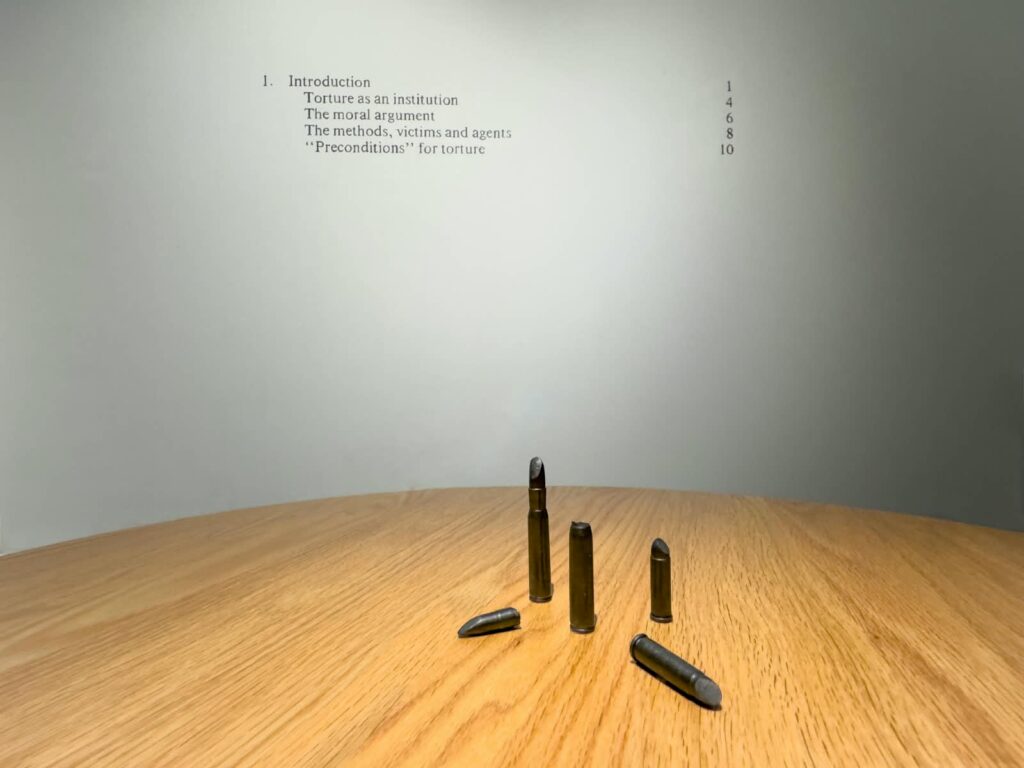
Joaquín Segura. Sin título (Tortura en los años ochenta), 2026 De la serie Separata, 2025–en curso Muro intervenido y proyectiles de grafito. Dimensiones variables.
submit the deepest parts of ourselves.
con la negativa a someter lo más profundo de nosotros mismos.
Hola, Jason, un saludo fraterno.
Hay cosas que no puedo contestar porque no sé. Muchas veces me pregunto: ¿qué estoy haciendo aquí?, en medio de monstruos que pueden devorarme en un minuto porque tienen el poder y la impunidad.
El tiempo me respondió sin darme cuenta, hasta escuchar el silencio, y desperté a la «rebelión de conciencia» frente a «los buenos» que no son coherentes entre el decir y el hacer.
Nací en la pobreza que nadie me enseñó y aprendí la rebeldía de la vida sin la angustia del hambre, y sin olvidar que siempre hay un nuevo amanecer.
Aprendí de campesinos, hombres y mujeres, indígenas, algunos religiosos; de esos místicos como Gandhi, Thomas Merton, de Luther King, Hildegarda, Lanza del Vasto, que lucharon sin perder la esperanza, sin armas, por medio de la no-violencia.
Nunca las luchas y resistencias por la liberación son obra de una sola persona; es sumar voluntades y despertar la rebeldía de conciencia. La libertad se construye paso a paso, estamos en camino.
Abrazos y buen trabajo de Alma Asfalto.
Adolfo Pérez Esquivel
Hello Jason, fraternal greetings.
There are things I cannot answer because I do not know. Many times I ask myself, what am I doing here, surrounded by monsters who could devour me in a minute because they have power and impunity?
Time answered me without my realizing it, until I listened to the silence and awakened to the “rebellion of conscience,” confronted with “the good people” who are not consistent between what they say and what they do.
I was born into poverty, which no one had to teach me about, and I learned the rebelliousness of life without the anguish of hunger, and not to forget that there is always a new dawn.
I learned from peasants, from Indigenous men and women, from some religious people, from those mystics—Gandhi, Thomas Merton, Martin Luther King, Hildegard, Lanza del Vasto—who struggled without losing hope, without weapons, through nonviolence.
Struggles and resistance for liberation are never the work of one person. It is about bringing wills together and awakening the rebellion of conscience. Freedom is built step by step. We are on the way.
An embrace, and good work with Alma Asfalto.
Adolfo Pérez Esquivel