El Banco de Francia
Pyotr Pavlensky
The Bank of France
Pyotr Pavlensky
Hace unos meses apareció en mi barrio, en la Ciudad de México, un espectacular de una película sobre Melania Trump. Pasaba frente a él todos los días hasta que ya no soporté que siguiera ahí, impune. Compré una lata de pintura negra en aerosol. Antes de salir, le escribí a un fotógrafo español que conozco —un hombre de impecables convicciones progresistas: Trump, el capitalismo, Gaza, Irán, la destrucción del planeta, todos los grandes éxitos—. Me dijo que no podía ayudarme. Como extranjero en México, no podía arriesgar su estatus migratorio. Yo tengo el mismo estatus. Olvidemos el espectacular. Olvidemos la pintura en aerosol. Lo que importa es el instante en que una creencia tiene que hacerse carne. Dos personas pueden creer que lo mismo es intolerable, enfurecerse contra los mismos sistemas, hablar el mismo hermoso lenguaje de la resistencia. Entonces la creencia exige algo. Hay que arriesgar algo.
Pavlensky hace de ese riesgo su medio. Hace de la agencia su arte.
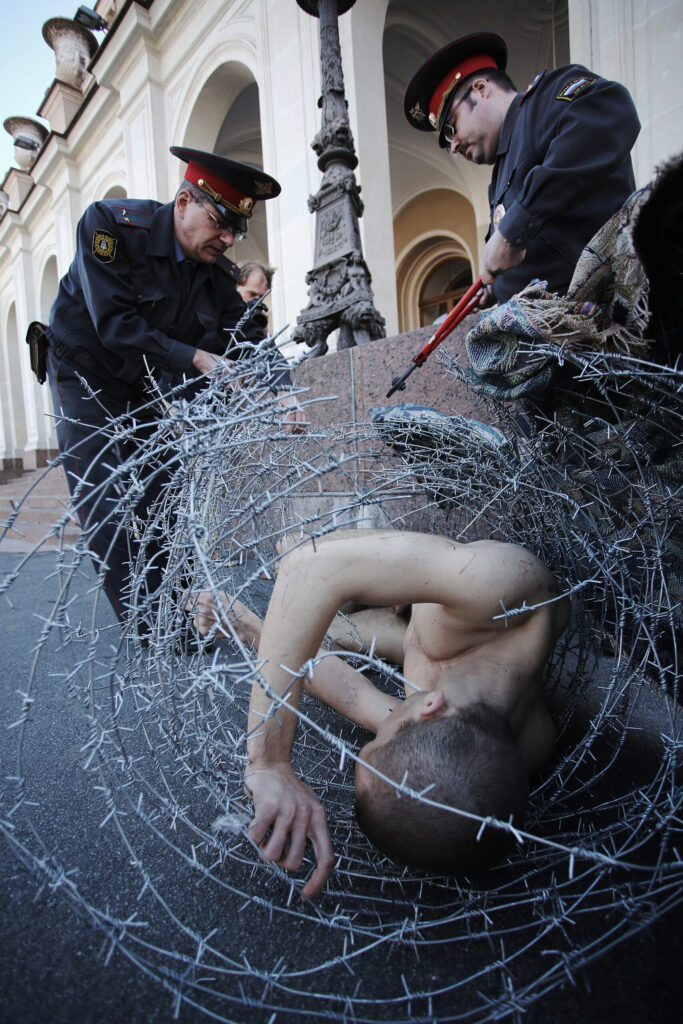
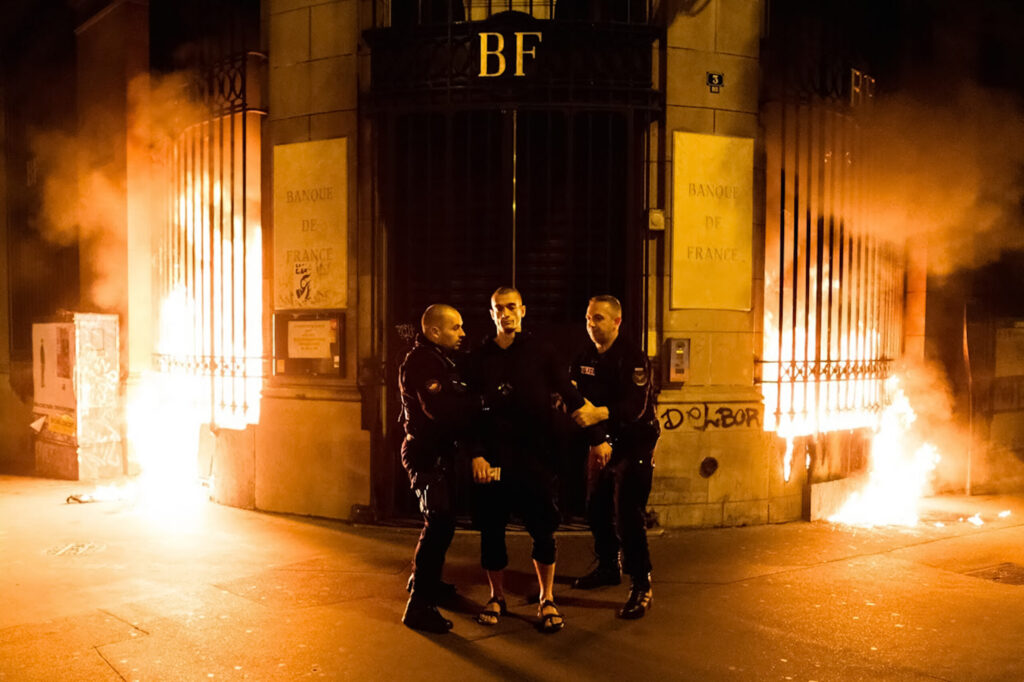
Pyotr Pavlensky se ha cosido la boca frente a la Catedral de Kazán. Ha permanecido desnudo, envuelto en alambre de púas, frente a la Asamblea Legislativa de San Petersburgo. Se ha clavado el escroto a la Plaza Roja. Se ha cortado parte de una oreja mientras estaba sentado sobre el muro de una institución psiquiátrica. Prendió fuego a las puertas del FSB —sucesor de la KGB— en Lubianka, se quedó frente a las llamas sosteniendo el bidón de gasolina y esperó a que lo arrestaran. Después de recibir asilo político en Francia, prendió fuego a la entrada del Banco de Francia. No son provocaciones seguidas de arte.
Son el arte: acontecimientos construidos para que policías, fiscales, jueces, prisiones y gobiernos sean arrastrados al interior de la obra y, al ejercer su poder contra él, se conviertan en parte de su creación.
Él llama a su práctica Arte Sujeto-Objeto. Crea la circunstancia, pone su cuerpo dentro de ella y espera. Llega la policía. Los fiscales procesan. Los jueces juzgan. Las puertas de la prisión se cierran. El poder se mueve contra él y entra en la obra. El Estado cree que está poniendo fin al acontecimiento. Lo está completando. La consecuencia es la forma. Los riesgos son reales. Ahí empieza el problema de la agencia: no se trata simplemente de lo que creemos, sino de lo que podemos hacer, lo que creemos que podemos hacer y lo que estamos dispuestos a perder al hacerlo. Pavlensky rechaza la comodidad de una convicción sin consecuencias. Su obra nos arroja al territorio incierto entre los límites que nos imponen y los límites que hemos aprendido a imponernos nosotros mismos. Quizá deteste la descripción, pero Pavlensky es uno de los grandes moralistas de nuestro tiempo.
AA: Has utilizado el poder mismo como material para el arte. Después de arrestos, prisión, juicios y exilio, ¿qué has aprendido sobre cómo se comporta realmente el poder cuando se le confronta?
PP: Para responder a tu pregunta, primero hay que responder otra: ¿qué es el poder? El poder es control y gobierno. Tener poder sobre alguien o algo significa tener la capacidad de controlar y gobernar a alguien o algo. El poder no es bueno ni malo: es simplemente un fenómeno inevitable, como el viento o la luz. Para que este fenómeno exista hacen falta dos elementos: quien gobierna y quien es gobernado. El primero, por lo tanto, es el sujeto del poder; el segundo, el objeto de subordinación.
Tradicionalmente, se considera que el arte debe trabajar para el poder, servir a sus intereses. Sin embargo, dentro de mi práctica artística, busco cambiar esta disposición tradicional entre el arte y el poder y hacer que el poder trabaje para el arte. Y lo más interesante es que, cuando consigo alcanzar este objetivo, la disposición cambia y los sujetos del poder se convierten en objetos del arte. Al mismo tiempo, son sus propias facultades de autoridad las que los obligan a convertirse en objetos del arte. Como puedes ver, en mi práctica artística todo está construido a partir de configuraciones de esta dicotomía sujeto/objeto, y precisamente por eso se llama Arte Sujeto-Objeto.
En cuanto a cómo se comporta el poder, sigue utilizando todos sus instrumentos de control y gobierno y busca eliminar al artista y su arte como un obstáculo que interfiere con el funcionamiento coordinado de sus sistemas.
AA: Tus acciones no terminan cuando actúas. La policía te arresta, los fiscales te acusan, los jueces te condenan, los periodistas hacen circular la imagen. ¿En qué momento la acción deja de ser tuya y quién se convierte entonces en el artista?
PP: Para empezar, lo que yo hago no se llama “acciones”; se llama “eventos”. La diferencia radica precisamente en que una acción no depende de la intervención ni de la participación de otras personas: puedes simplemente salir todos los días a una esquina, gritar durante un minuto, y eso por sí solo ya constituiría una acción. Para que tenga lugar un evento, en cambio, tiene que empezar a formarse una especie de vórtice que arrastre a personas completamente distintas y las obligue a moverse en una dirección que ellas mismas no conocen del todo.
En cuanto a la autoría en el Arte Sujeto-Objeto, la tarea inicial del artista consiste en crear circunstancias que obliguen a los representantes de la autoridad a empezar a ejercer sus facultades de poder y, mediante el ejercicio de esas facultades, comiencen a realizar la intención del artista, de la que no saben nada. A partir de ahí, hasta que concluye el proceso judicial, el artista no necesita hacer nada. Después, sin embargo, debe hacer una selección entre los materiales del expediente penal y elegir imágenes que tengan valor estético y expresen los significados necesarios dentro del contexto del evento que ha tenido lugar. Luego muestra esas imágenes en exposiciones y las vende a colecciones de arte.
Así, desde el momento en que comienza el evento, el poder trabaja para el arte en cada etapa, pero el artista sigue siendo el autor, porque todo comienza con la idea original del artista, su intención artística y la imagen que ha concebido. El artista también hace la selección final de todos los materiales y decide qué se mostrará en exposiciones y se venderá a colecciones de arte, y qué no.
AA: Construiste una práctica alrededor de la confrontación con el poder visible: la policía, los tribunales, las prisiones, el Estado. Ahora gran parte del poder es más difícil de ver y opera a través de sistemas que moldean lo que la gente ve y desea. ¿Cómo confrontas al poder cuando ya no tiene una puerta a la que puedas prenderle fuego?
PP: Yo no me opongo al poder. Cambio la disposición entre el arte y el poder y hago que el poder trabaje para el arte. A eso algunos filósofos franceses lo llamaron la “mecánica del poder”: precisamente aquello que permanece oculto bajo la atractiva fachada exterior del poder y que, por lo tanto, no siempre resulta evidente a primera vista. Sin embargo, en el caso del Arte Sujeto-Objeto, esa mecánica siempre termina revelándose y haciéndose bastante evidente.
Incluso ahora, hace unos meses, me enteré de que las autoridades francesas habían iniciado un procedimiento para retirarme el asilo político en Francia exactamente por lo mismo por lo que me lo habían concedido. Me concedieron asilo por mi práctica artística (en Rusia), y ahora me están retirando ese asilo porque continué con mi práctica artística (en Francia).
Así, incluso en este caso, podemos ver que en la superficie existe una atractiva fachada del poder, que se presenta diciendo: “Francia es el alma mater de todos los artistas”, “Francia es el hogar de las artes y de todos los artistas del mundo”; mientras que debajo se encuentra la verdadera mecánica de ese poder, que expulsa de su territorio a los artistas que no le sirven y elimina cualquier arte que no sirva a los intereses de ese poder.
AA: Tu obra elimina la distancia entre un acto artístico y sus consecuencias. ¿Las consecuencias son necesarias para la resistencia? ¿Tiene que haber algo real en juego?
PP: Necesito las consecuencias no para la resistencia. Necesito las consecuencias para que lo que he hecho pueda convertirse en un evento. El artista no crea el evento por sí mismo. Sería demasiado presuntuoso de su parte siquiera pensar que es capaz de hacerlo. El artista solo puede crear una circunstancia. Y el evento lo crean las consecuencias de esa circunstancia.
AA: Si las instituciones no deciden los límites de la acción artística, ¿quién los decide? ¿Dónde encuentra sus propios límites un artista autónomo?
PP: En esto, el artista solo puede confiar en su intuición artística. Y sí, lo mismo ocurre con muchas otras cuestiones relacionadas con el arte. El punto es que precisamente ahí reside una de las principales dificultades para crear una obra de arte genuinamente nueva. El cálculo puro, el análisis e incluso el dominio del más alto nivel de técnica no sirven, porque si el artista se apoya únicamente en estas cosas, todas sus obras serán inevitablemente secundarias. Es decir, serán intentos más o menos logrados de imitar obras que ya se han vuelto icónicas y universalmente reconocidas.
Por lo tanto, para poder avanzar, el artista tiene que arriesgarse. Y si su intuición artística no le falla, logrará crear una obra genuinamente nueva. Pero cuanto más nueva e inesperada sea la forma de su obra, mayor será el rechazo y la resistencia a aceptarla. Por un lado, a la gente le cuesta percibir como arte algo que todavía no está acostumbrada a percibir como arte; por otro, las instituciones siempre persiguen sus propios objetivos pragmáticos. Apoyan y promueven aquellas formas y movimientos artísticos ya establecidos que sirven a los intereses nacionales de los Estados que financian y controlan esas instituciones.
AA: Las imágenes de tus acciones han viajado mucho más allá de las acciones mismas. Cuando la resistencia se convierte en una imagen consumida por millones, ¿ha roto el espectáculo o el espectáculo la ha absorbido?
PP: Mira, este término, “espectáculo”, pertenece al discurso de Guy Debord en La sociedad del espectáculo. Odio a Guy Debord por sus mentiras y su palabrería vacía. Es un hombre que, por alguna razón, se metió en el territorio del arte y empezó a gritar que “debemos abandonar la imagen; la imagen es el principal mal”, y así sucesivamente. Hmm… sin duda suena radical. Pero ¿qué ofrece a cambio?
Lo que Guy Debord ofrece a cambio es escribir ensayos y crítica y producir toda clase de textos. En otras palabras, simplemente dedicarse a la literatura. Y eso significa vivir la vida de los escritores, buscar una editorial prestigiosa o con autoridad, colaborar con casas editoriales, etcétera. Pero la literatura y la escritura han existido perfectamente bien durante miles de años sin Guy Debord, y el texto, como forma de expresión, tradicionalmente y por regla general ha sido colocado por encima de la imagen. Todas las religiones se apoyan en textos, en libros sagrados, pero no todas permiten el uso de imágenes; el desarrollo de las civilizaciones suele evaluarse a partir del desarrollo de la escritura, y el desarrollo de un individuo se evalúa por su alfabetización, es decir, por su capacidad para leer y escribir.
En cuanto a los filósofos, Platón, hablando a través de Sócrates, ya atacaba a los artistas, considerándolos imitadores sin valor de las cosas materiales. Así que Guy Debord no nos dice ni nos ofrece nada nuevo, pero con una pomposidad y un patetismo increíbles se presenta como un innovador radical y un destructor de los fundamentos establecidos. Era un hombre completamente falso y vacío.
Si dejamos de lado la palabra “espectáculo” y respondemos a tu pregunta sobre la imagen, entonces el arte está precisamente para crear nuevas imágenes. La función del arte es convertir la realidad en imágenes. Convertir no su superficie, sino su esencia. Porque, de lo contrario, la función del arte no sería distinta de la de una cámara.
AA: El poder puede encarcelar a un artista, pero también puede exhibirlo, hacerlo circular y convertir su resistencia en cultura. ¿Qué es más peligroso para la resistencia: la represión o la aceptación?
PP: A mí solo me interesa la libertad artística. Por lo tanto, para mí es incuestionable que, si el Arte Sujeto-Objeto se convierte en un fenómeno más extendido dentro de la cultura, traerá beneficios indiscutibles para los artistas y para el arte en su conjunto. Porque hoy, hasta donde sé, solo la teoría del Arte Sujeto-Objeto ofrece una metodología que permite al artista evitar la dependencia del poder económico y político y, al mismo tiempo, crear obras de arte significativas, que siempre requieren considerables recursos financieros y humanos. En otras palabras, permite que el arte sea verdaderamente independiente.
AA: ¿Dónde termina el arte y empieza la resistencia, o esa distinción es en sí misma falsa?
PP: La palabra “resistencia” es un término muy amplio. En esencia, cualquier negativa a someterse a las circunstancias existentes ya puede llamarse resistencia. Es como la definición de la vida del fisiólogo Xavier Bichat: “La vida es el conjunto de funciones que resisten a la muerte”.
Si por “resistencia” te refieres específicamente a la resistencia política de una ideología política contra otras ideologías políticas, entonces que el arte se ponga del lado de una ideología u otra es absolutamente fatal, porque en ese caso el arte queda inevitablemente reducido a un instrumento de propaganda de la ideología cuyo bando ha elegido. Y cualquier propagandista no es más que un lacayo que ha elegido a su amo por una razón egoísta u otra y ha renunciado a su propia opinión.
Un artista, en cambio, hace todo únicamente por el arte y en interés del arte, y por eso es un hueso atorado en la garganta de cualquiera que persiga intereses políticos de cualquier tipo. Y si hoy un grupo político admira a un artista porque sus adversarios políticos lo odian, mañana empezará a odiarlo exactamente de la misma manera, porque el arte cuestiona y refuta toda ideología política existente.
Después de todo, las ideologías son el mal más terrible: en esencia, son programas estandarizadores, como programas de computadora, que una persona instala en lugar de su propia mente única, distinta de la de todos los demás, y después pierde la capacidad de pensar y de ver el mundo que la rodea con sus propios ojos.
Months ago, a billboard for a Melania Trump film went up in my neighborhood in Mexico City. I passed it every day until I couldn’t stand that it existed with impunity. I bought a can of black spray paint. Before going out, I wrote a Spanish photographer I know—a man of impeccable progressive convictions: Trump, capitalism, Gaza, Iran, the destruction of the planet, all the hits. He told me he couldn’t help. As a foreigner in Mexico, he couldn’t risk his legal status. I have the same status. Forget the billboard. Forget the spray paint. What matters is the instant belief is asked to become flesh. Two people can believe the same thing is intolerable, rage against the same systems, speak the same beautiful language of resistance. Then belief makes a demand. Something has to be risked.
Pavlensky makes that risk his medium. He makes agency his art.
Pyotr Pavlensky has sewn his mouth shut in front of Kazan Cathedral. He has lain naked, wrapped in barbed wire, outside the Legislative Assembly in St. Petersburg. He has nailed his scrotum to Red Square. He has cut off part of his ear while sitting on the wall of a psychiatric institution. He set fire to the doors of the FSB—the successor to the KGB—at Lubyanka, stood before the flames holding the gasoline can, and waited to be arrested. After receiving political asylum in France, he set fire to the entrance of the Bank of France. These are not provocations followed by art. They are the art: events constructed so that police, prosecutors, judges, prisons and governments are pulled inside the work and, by exercising their power against him, become part of its creation.
He calls his practice Subject-Object Art. He creates the circumstance, puts his body inside it, and waits. Police arrive. Prosecutors prosecute. Judges judge. Prison doors close. Power moves against him and enters the work. The state thinks it is ending the event. It is completing it. The consequence is the form. The risks are real. This is where the question of agency begins: not simply with what we believe, but with what we can do, what we believe we can do, and what we are willing to lose by doing it. Pavlensky refuses the comfort of conviction without consequence. His work throws us into the uncertain territory between the limits imposed upon us and the limits we have learned to impose upon ourselves. He might hate the description, but Pavlensky is one of the great moralists of our time.
AA: You’ve used power itself as material for art. After arrests, prison, trials and exile, what have you learned about how power actually behaves when confronted?
PP: To answer your question, one must first answer the question: what is power? Power is control and governance. To have power over someone or something means to have the ability to control and govern someone or something. Power is neither good nor bad—it is simply an inevitable phenomenon, like wind or light. For this phenomenon to exist, two elements are necessary: the one who governs and the one who is governed. The first element, accordingly, is the subject of power, and the second is the object of subordination.
Traditionally, it is believed that art should work for power, serving its interests. However, within the framework of my artistic practice, I seek to change this traditional disposition between art and power and to make power work for art. And what is most interesting is that when I succeed in achieving this goal, the disposition changes, and the subjects of power become the objects of art. At the same time, it is their own powers of authority that compel them to become objects of art. As you can see, in my artistic practice everything is built upon configurations of this subject/object dichotomy, and this is precisely why it is called Subject-Object Art.
As for how power behaves, it continues to use all its instruments of control and governance and seeks to eliminate the artist and his art as an obstacle that interferes with the coordinated functioning of its systems.
AA: Your actions don’t end when you act. Police arrest you, prosecutors charge you, judges sentence you, journalists circulate the image. At what point does the action stop being yours—and who becomes the artist after that?
PP: First of all, what I do is not called “actions”; it is called “events.” The difference lies precisely in the fact that an action does not depend on the involvement and participation of other people—you can simply go out to an intersection every day, shout there for one minute, and that alone would already constitute an action. For an event to take place, however, a certain vortex has to begin to form, drawing completely different people into it and compelling them to move in a direction that is not fully known to them.
As for authorship in Subject-Object Art, the artist’s initial task is to create circumstances that compel representatives of authority to begin exercising their powers of authority, and through the exercise of those powers they begin to realize the artist’s intention, of which they know nothing. After that, until the judicial proceedings are concluded, the artist does not need to do anything. Afterwards, however, the artist must make a selection from the materials of the criminal case and choose images that possess aesthetic value and express the meanings necessary in the context of the event that has taken place. The artist then shows these images at exhibitions and sells them to art collections.
Thus, from the moment the event begins, power works for art at every stage, but the artist still remains the author, because everything begins with the artist’s original idea, his artistic intent, and the image he has conceived. The artist also makes the final selection from all the materials and decides what will be shown at exhibitions and sold to art collections, and what will not.
AA: You built a practice around confronting visible power: police, courts, prisons, the state. Now much of power is harder to see, operating through systems that shape what people see and desire. How do you confront power when it no longer has a door you can set on fire?
PP: I do not oppose power. I change the disposition between art and power and make power work for art. What you are talking about was called the “mechanics of power” by some French philosophers—it is precisely what is hidden beneath the attractive external façade of power and is therefore not always obvious at first glance. However, in the case of Subject-Object Art, these mechanics always reveal themselves and become quite obvious.
Even now, a few months ago, I learned that the French authorities had initiated a procedure to deprive me of political asylum in France for exactly the same thing for which I had been granted that asylum. I was granted asylum because of my artistic practice (in Russia), and now they are depriving me of that asylum because I continued my artistic practice (in France).
Thus, even in this case, we can see that on the surface there is an attractive external façade of power, which presents itself as “France is the alma mater of all artists,” “France is the home of the arts and of all the artists of the world,” while beneath it lies the actual mechanics of this power, which expels from its territory artists who are useless to it and eliminates any art that does not serve the interests of this power.
AA: Your work eliminates the distance between an artistic act and its consequences. Is consequence necessary for resistance? Does something real have to be at stake?
PP: I need the consequences not for resistance. I need the consequences so that what I have done can become an event. The artist does not create the event himself. It would be far too presumptuous on his part even to think that he is capable of doing so. The artist can only create a circumstance. And the event is created by the consequences of that circumstance.
AA: If institutions don’t get to decide the limits of artistic action, who does? Where does an autonomous artist find his own limits?
PP: In this, the artist can rely only on his artistic intuition. And yes, the same is true of many other things concerning art. The point is that this is precisely where one of the main difficulties of creating a genuinely new work of art lies. Pure calculation, analysis, and even the possession of the highest level of technical skill will not help, because if the artist relies only on these things, all of his works will inevitably be secondary. That is, they will be more or less successful attempts to imitate works that have already become iconic and universally recognized.
Therefore, in order to move forward at all, the artist must take a risk. And if his artistic intuition does not fail him, he will succeed in creating a genuinely new work. But the newer and more unexpected the form of his work of art is, the greater the rejection and refusal to accept it will be. On the one hand, it is difficult for ordinary people to perceive as art something they are not yet accustomed to perceiving as art; on the other hand, institutions also always pursue their own pragmatic goals. They support and promote those already established forms and movements of art that serve the national interests of the states that finance and control these institutions.
AA: The images of your actions have traveled far beyond the actions themselves. When resistance becomes an image consumed by millions, has it broken the spectacle—or has the spectacle absorbed it?
PP: Listen, this term “spectacle” belongs to Guy Debord’s discourse in The Society of the Spectacle. I hate Guy Debord for his lies and empty talk. He is a man who, for some reason, intruded into the territory of art and began shouting that “we must abandon the image; the image is the principal evil” and so on and so forth. Hmm… it certainly sounds radical. But what does he offer in return?
What Guy Debord offers in return is to write essays and criticism and to produce all sorts of other kinds of texts. In other words, simply to engage in literature. And that means living the life of writers, looking for a prestigious or authoritative publisher, collaborating with publishing houses, and so on. But literature and writing have existed perfectly well for many thousands of years without Guy Debord, and text, as a form of expression, has traditionally, as a rule, been placed above the image. All religions rely on texts, on sacred books, but far from all of them permit the use of images; the development of civilizations is often assessed by the development of writing, and the development of an individual is assessed by his literacy, that is, his ability to read and write.
As for philosophers, Plato, speaking through Socrates, already attacked artists, regarding them as worthless imitators of material things. Thus, Guy Debord tells us and offers us nothing new, but with incredible pomposity and pathos presents himself as a radical innovator and a subverter of established foundations. He was an utterly false and empty man.
If we disregard the word “spectacle” and answer your question about the image, then art is precisely supposed to create new images. The function of art is to convert reality into images. To convert not its surface, but its essence. Because otherwise, the function of art would be no different from that of a camera.
AA: Power can imprison an artist, but it can also exhibit him, circulate him and turn his resistance into culture. Which is more dangerous to resistance: repression or acceptance?
PP: I am interested only in artistic freedom. Therefore, it is unquestionable to me that if Subject-Object Art becomes a more widespread phenomenon in culture, it will bring undeniable benefits to artists and to art as a whole. Because today, as far as I know, only the theory of Subject-Object Art offers a methodology that allows the artist to avoid dependence on economic and political power while at the same time creating significant works of art, which always require substantial financial and human resources. In other words, it allows art to be truly independent.
AA: Where does art end and resistance begin—or is that distinction itself false?
PP: The word “resistance” is a very broad term. In essence, any unwillingness to submit to existing circumstances can already be called resistance. It is like the physiologist Xavier Bichat’s definition of life: “Life is the set of functions that resist death.”
If by “resistance” you mean specifically political resistance on the side of one political ideology against other political ideologies, then for art to take the side of one ideology or another is absolutely fatal, because in that case art is inevitably reduced to an instrument of propaganda for the ideology whose side it takes. And any propagandist is simply a lackey who has chosen his master for one selfish reason or another and has renounced his own opinion.
An artist, on the other hand, does everything solely for art and in the interests of art, and because of this, he is a bone stuck in the throat of anyone pursuing political interests of any kind. And if today one political group admires an artist because their political opponents hate him, tomorrow they will begin to hate him in exactly the same way, because art calls into question and refutes every existing political ideology.
After all, it is ideologies that are the most terrible evil—in essence, they are standardizing programs, like computer programs, which a person installs in place of his own unique mind, different from everyone else’s, and after that, he loses the ability to think and to see the world around him with his own eyes.